
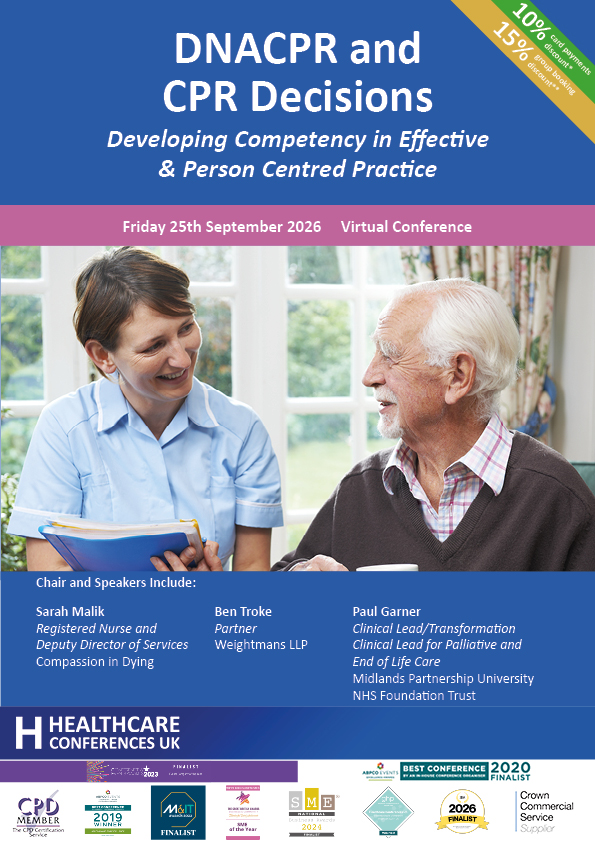
This conference focuses on developing your skills, knowledge and confidence in making, documenting and communicating DNACPR and CPR decisions as part of effective, person centred care.
Cardiopulmonary resuscitation decisions remain one of the most sensitive and complex areas of clinical practice. Done well, they support personalised care, informed decision making and clear planning for future emergencies. Done badly, they can cause distress for patients and families, create confusion for staff, and lead to poor communication, conflict and inconsistent practice across care settings.
“Do not attempt cardiopulmonary resuscitation (DNACPR) recommendations were often inconsistently applied, poorly discussed, and frequently misunderstood.”
Resuscitation Council UK, ReSPECT Policy Briefing, updated February 2026
“Placing CPR decisions within the wider context of a person’s overall goals of care reduced misunderstandings, improved communication, and decreased preventable harms.”
Resuscitation Council UK, ReSPECT Policy Briefing, updated February 2026
“Although they found some examples of good practice, they also found that there were inconsistencies in approach, language, communication and understanding about ‘do not attempt cardiopulmonary resuscitation’ decision making and the wider context of advance care planning.”
NHS England
Through national guidance, legal update, practical case studies and interactive role play, this conference will support delegates to strengthen competence in effective DNACPR discussions and ensure decisions are made as part of wider goals of care. The day will focus on improving communication with patients and families, understanding the legal and ethical framework, applying the Mental Capacity Act in practice, and developing confidence in treatment escalation planning, anticipatory care planning and advance care planning conversations.
The conference will also examine how to normalise conversations about resuscitation, ensure patients are empowered to make informed decisions about their care, and improve the quality of documentation and decision sharing across teams and organisations. Delegates will hear practical examples from clinical leaders in palliative care, critical care, end of life care, law and personalised care, with a particular focus on compassionate, clear and person centred practice.
The optional end-of-day workshop will specifically focus on DNACPR in Community Care, addressing the additional challenges of communication, mental capacity, best interests, review processes and ensuring decisions are recognised and shared effectively across all care settings.
This conference will enable you to:
Network with colleagues who are working to improve the communication and management of DNACPR decisions
Understand DNACPR decisions in the context of wider anticipatory clinical management planning and treatment escalation
Update their knowledge of the legal and ethical framework, including consent, capacity and best interests
Improve confidence in leading compassionate, person-centred DNACPR discussions
Recognise good and poor practice in communication and decision-making
Strengthen documentation and recording of DNACPR and escalation decisions
Explore how to communicate decisions clearly within teams and across settings
Learn how role play, case discussion and competency-based training can improve practice ensure CPR decisions are made as part of wider goals of care and emergency care planning
Understand how to apply capacity and best interests principles in real-world situations
Develop competence in managing DNACPR decisions in acute, community care and across care settings
Self-assess, reflect, and expand your skills in DNACPR support and decision making
Support CPD professional development and provide revalidation evidence. This course provides 5 hours’ training for CPD, subject to peer group approval for revalidation purposes
“Training should have clear learning outcomes, covering: the legal requirement to communicate a DNACPR decision… communicating the decision using a human rights-led approach… what is meant by appropriate documentation… examples of good practice conversations, including the importance of empathy in conversations and de-escalation…”
Parliamentary and Health Service Ombudsman, End-of-life care: improving ‘do not attempt CPR’ conversations for everyone