
Follow the conference on social media #IVTherapy
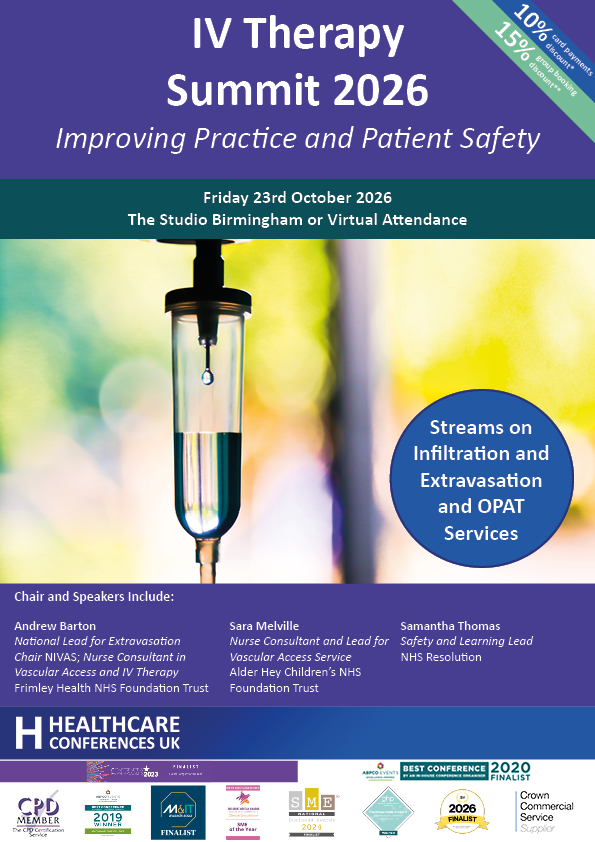
The National IV Therapy Summit 2026 will focus on improving practice and patient safety in vascular access and intravenous infusion therapy across hospital, community, OPAT and Hospital at Home services. There will be a focus on implementing the 2026 National Standards for Vascular Access and Intravenous Infusion Therapy. The National Infusion and Vascular Access Society (NIVAS) is introducing new UK standards in 2026, featuring over 150 evidence-based standards covering device selection, insertion, care, and complication management and expected to be published in July 2026. These standards provide an important opportunity for NHS organisations to review practice, improve consistency, strengthen governance and ensure staff are competent and confident in the safe delivery of IV therapy. The Summit will support delegates to understand the new standards, assess current practice, identify gaps, and develop practical approaches to implementation.
Intravenous therapy is an essential part of modern healthcare, but it is not without risk. Poor device selection, delayed recognition of complications, inadequate training, inconsistent escalation, and variation in documentation or reporting can lead to avoidable harm. Infiltration and extravasation remain significant patient safety issues, with potential for pain, tissue damage, long-term injury and litigation. The Summit will provide a practical focus on prevention, early recognition, management, follow-up and learning from incidents and claims.
The conference will also examine the expansion of OPAT services, including COpAT, virtual wards, rapid response IV services and Hospital at Home. NHS England’s 2025 OPAT guidance emphasises the need for integrated OPAT and complex oral/parenteral antimicrobial therapy services, with clear governance, patient selection criteria, monitoring, documentation, quality assurance and education for staff delivering the service.
Delegates will have the opportunity to attend one of two focused streams:
Stream A: Improving Patient Safety in IV Therapy — Infiltration and Extravasation
This stream will focus on reducing avoidable harm from infiltration and extravasation through improved training, early recognition, escalation, treatment, follow-up, standardised reporting and learning from practice.
“The advantages of intravenous therapy include improved patient outcomes and survival due to constant drug bioavailability and consistent therapeutic drug levels in the blood. Unfortunately, the use of intravenous therapies is not without risk. While the benefits of using intravenous therapy usually outweighs such risks, it is necessary for all staff involved with such therapies to have sound knowledge of potential complications. ..Occasionally the administration of IV therapies can go wrong. Infiltration and Extravasation is a complication whereby the drug or IV therapy leaks into the tissues surrounding the vascular access device. Extravasation is often associated with chemotherapy agents; however nonchemotherapy drugs have been reported as having a greater risk of serious complications. Extravasation may cause serious and often life changing injuries. This tool kit is designed to highlight the risks of infiltration and extravasation and facilitate healthcare organisations to implement best practice to improve patient safety and experience.”
Andrew Barton Nurse Consultant IV therapy & Vascular access NIVAS Chair, Infiltration and Extravasation A toolkit to improve practice
Stream B: Expanding and Improving Practice in OPAT Services
This stream will focus on developing safe, effective and sustainable OPAT, COpAT and community IV therapy services, including governance, competence, antimicrobial stewardship, Hospital at Home models, virtual wards, rapid response IV pathways and patient safety outside the hospital setting.
“OPAT services can deliver high quality, convenient patient care that achieves similar outcomes to inpatient treatment. They can help appropriate patients with infections to return to normal lives, allowing adults to return to work, children to return to school and older patients to maintain their independence. This benefits them, wider society and the economy. Avoidable healthcare-associated infections and the resulting morbidity and costs can be minimised.”
NHS England 2025
The day will bring together vascular access specialists, IV therapy teams, OPAT leads, infection specialists, pharmacists, community IV teams, Hospital at Home services, patient safety leads and senior nurses to share learning, examine current challenges and support implementation of best practice.
Final joint stream sessions will focus on the important issues of auditing and assessing practice against the 2026 clinical standards, managing the difficult to access iv access patient and a focus on learning from claims.
This conference will enable you to:
Network with colleagues who are working to improve IV Therapy Practice
Understand the key principles and support practical implementation of the 2026 UK Clinical Standards for Vascular Access and Intravenous Infusion Therapy
Review current national developments in IV therapy, vascular access, OPAT and Hospital at Home
Assess local practice against the new standards and identify areas for improvement
Improve governance, audit, training and competence in vascular access and IV therapy
Develop safer approaches to device selection, vessel health and preservation
Improve prevention, early recognition and management of infiltration and extravasation
Understand the human factors, training and system issues that contribute to IV therapy-related harm
Learn from NHS Resolution claims and incident data relating to extravasation injury
Improve escalation, follow-up and reporting of IV therapy complications
Understand how OPAT services are developing in line with NHS England guidance
Improve patient safety in IV Therapy
Support safe care closer to home through clear governance, monitoring and escalation processes
Develop practical strategies for difficult IV access patients, including improved communication and patient-centred care
Take away examples of good practice from NHS services working to improve IV therapy and OPAT safety
Self assess and reflect on your own practice
Supports CPD professional development and acts as revalidation evidence. This course provides 5 Hrs training for CPD subject to peer group approval for revalidation purposes