
Follow the conference on social media #AdultSuicide
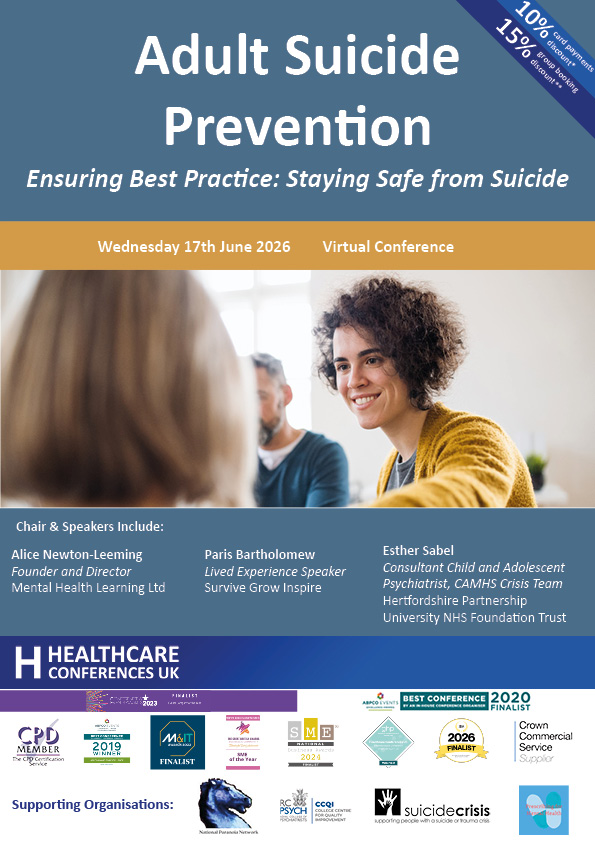
This conference will explore national policy developments, emerging evidence and practical approaches to adult suicide prevention, including learning from the NHS England ‘Staying Safe from Suicide’ guidance, which emphasises compassionate, person-centred responses across all settings.
“Our deepest hope is that these insights will transform how lived experience shapes suicide prevention – from policy creation to frontline care. Every person deserves to feel truly seen and supported in their darkest moments.”
Staying safe from suicide guidance, NHS England, June 2025
According to the latest Adult Psychiatric Morbidity Survey, rates of suicidal thoughts, suicide attempts and self-harm among adults in England remain unacceptably high, with a significant proportion of adults reporting that they have experienced suicidal thoughts at some point in their lives. These findings underline the scale of need and the importance of sustained, system-wide action on suicide prevention across health, social care and community services.
“Around one in four adults (25.2%) reported that they had had thoughts of taking their own life at some point in their life, equating to an estimated 11.7 million adults in England.”
Adult Psychiatric Morbidity Survey: Survey of Mental Health and Wellbeing, England, November 2025
“One in thirteen adults (7.8%) reported having made a suicide attempt at some point in their life, an estimated 3.6 million adults.”
Adult Psychiatric Morbidity Survey: Survey of Mental Health and Wellbeing, England, November 2025
We will examine the different sections of the guidance and discuss ways it can be implemented in your practice. Sessions will highlight the importance of language, training staff to embed the guidance, crisis prevention and planning, and understanding how safety formulation differs from traditional risk assessments.
Through expert-led sessions and case studies, this conference will consider how services can reduce suicide risk by identifying and providing support with a person cantered approach, and addressing known risk factors such as isolation, stigma, and barriers to help-seeking, particularly for men and neurodivergent people.
“In England, around one in 13 adults reported having attempted suicide at some point in their life, and we know that people living with a common mental illness are five times more likely to attempt to take their own lives, and those with a severe mental illness like schizophrenia, ten times more likely. This is deeply concerning, and we must ensure adequate care and treatment is available.””
Dr Lade Smith CBE, President of the Royal College of Psychiatrists, 10th September 2025
This conference will enable you to:
Network with colleagues who are working to improve suicide prevention across services
Learn from outstanding practice in suicide prevention
Ensure you understand and adhere to the 2025 National Staying Safe from Suicide Guidance
Improve the way you manage safety planning and crisis prevention
Understand how Safety Formulation differs from standard risk assessments
Support ongoing learning and support for mental health staff
Understand how language can reduce stigma and support disclosure when discussing suicide
Reflect on strategies to train staff and embed the guidance into practice
Develop your skills in supporting neurodivergent people at risk of suicide
Learn from safety issues for adults in mental health crisis in urgent and emergency care
Reflect on ways to keep patients safe from chemically induced crisis
Develop your skills in person centred approaches to assessing risk of suicide
Self assess and reflect on your own practice
Supports CPD professional development and acts as revalidation evidence. This course provides 5 hours training for CPD subject to peer group approval for revalidation purposes