
The Department of Health and Social Care (DHSC) and NHS England have published a delivery framework designed to improve care for people experiencing both mental health and substance use conditions, setting out a national programme to deliver more integrated and person-centred support across England.
Published in December 2025, the Co-occurring Mental Health and Substance Use Delivery Framework acknowledges that people with both mental health and substance use problems have historically struggled to access appropriate treatment, often finding themselves excluded from services or referred between multiple providers without receiving adequate support.
The framework highlights the scale of the challenge facing health services. According to government figures, 74% of people starting drug and alcohol treatment between 2024 and 2025 had a mental health treatment need. It also notes that more than one-third of people with serious mental illness have co-existing drug or alcohol conditions, while individuals with co-occurring problems who are not engaged with specialist services face an increased risk of suicide.
Officials said the current system too often requires people to "fit services, rather than services meeting people's needs". The framework draws attention to long waits for diagnosis, fragmented pathways between mental health and substance use services, and the need for patients to repeatedly retell their experiences when accessing support.
The new strategy is built around four priority areas:
- Strategic leadership and service model design
- Data collection, sharing and monitoring
- Workforce development and training
- Commissioning arrangements and incentives
The government said these areas will form the basis of a coordinated effort to improve access, quality and outcomes for people with co-occurring conditions.
A central principle of the framework is that treating co-occurring conditions should be "everyone's job", requiring mental health and substance use services to work together rather than operate separately. The document also promotes a "no wrong door" approach, under which people can access support regardless of which service they first contact.
As part of the national programme, DHSC will:
- Develop statutory duty-to-cooperate guidance to clarify how local authorities and NHS organisations should work together
- Produce a quality standard checklist for joint care planning
- Work with the Care Quality Commission to ensure co-occurring conditions are better reflected in inspections and regulatory frameworks
Meanwhile, NHS England has committed to:
- Publishing a positive practice guide to strengthen collaboration between talking therapies and drug and alcohol services
- Establishing networks to share best practice
- Promoting trauma-informed and person-centred approaches to care
The framework places significant emphasis on improving data collection and monitoring. NHS England will promote the use of the ASSIST-Lite screening tool across mental health services to identify substance use problems more consistently.
Workforce development is also identified as a key priority. The framework cites concerns raised by Dame Carol Black's independent review of drugs about declining capacity, capability and morale within the drug and alcohol treatment workforce.
The report calls for:
- Greater workforce training across mental health and substance use services
- Wider adoption of trauma-informed care
- Increased use of motivational interviewing techniques
- Improved collaboration between specialist and community-based services
The government said improving care for people with co-occurring mental health and substance use conditions will support wider NHS reforms, including efforts to shift care from hospitals into community settings, reduce health inequalities and lower demand for crisis services.
Officials acknowledged that meaningful change will require sustained commitment across all levels of the healthcare system, including commissioners, providers, clinicians and service leaders. The framework concludes that improving integrated care has the potential not only to improve outcomes for patients but also to reduce pressure on NHS and local authority services more broadly.
Source: GOV.uk
Are you working to improve outcomes for people with co-occurring mental health and substance use conditions?
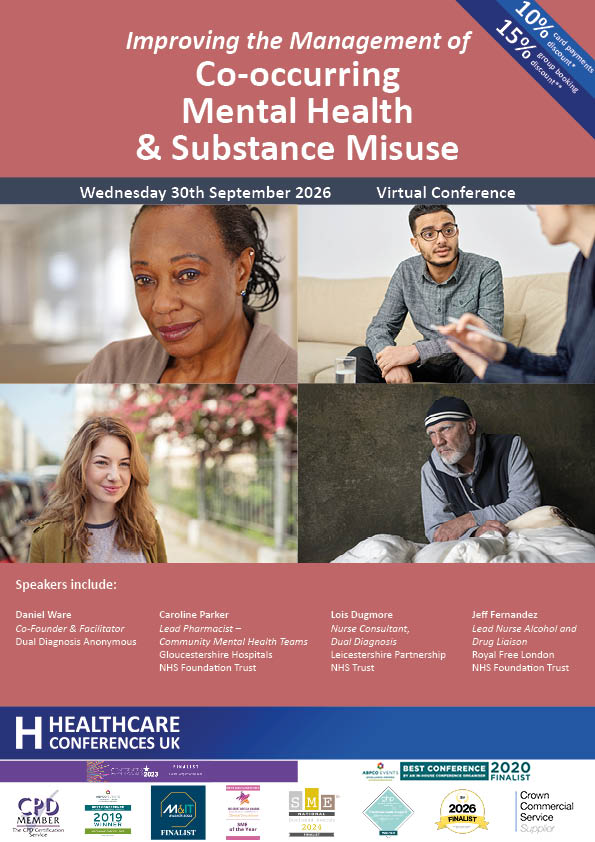 Join us for our upcoming Improving the Management of Co-occurring Mental Health and Substance Misuse virtual CPD conference on Wednesday 30th September 2026.
Featuring expert speakers from NHS trusts and specialist services, the event offers practical insights into delivering integrated, person-centred care and provides 5 hours of CPD training, subject to peer group approval for revalidation purposes.
The conference will explore evidence-based approaches to supporting people with co-occurring conditions, with sessions covering:
- Challenging stigma and improving access to services
- Early intervention and prevention strategies
- Effective assessment and assertive outreach
- Supporting people experiencing homelessness
- Implementing current guidance and quality standards
- Developing peer support networks and improving engagement
To view the full programme and book your place, visit: www.healthcareconferencesuk.co.uk/virtual-online-courses/substance-misuse-mh