
Follow the conference on social media #NHSComplaints
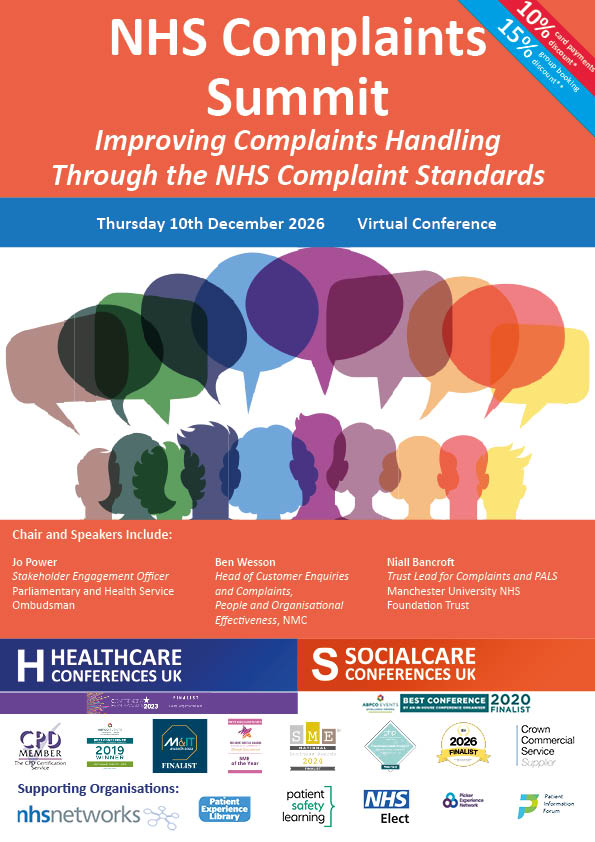
This National Summit focuses on improving NHS complaints handling and supporting services to implement, embed and evidence adherence to the PHSO NHS Complaint Standards.
The conference takes place at a critical time for complaints reform. The 10 Year Health Plan for England is clear that the NHS complaints procedure is far from where it needs to be, and commits to updating complaints regulations, setting clearer standards for the timeliness and quality of responses, improving response times, and increasing the use of AI tools to support faster collection and response to complaints data.
“We are seeing an unprecedented increase in the number of complaints coming to us—25% to 30% this year.”
Paula Sussex CBE, Parliamentary and Health Service Ombudsman, House of Commons Public Administration and Constitutional Affairs Committee, 24 February 2026
The Department of Health and Social Care’s Review of patient safety across the health and care landscape, led by Dr Penny Dash, also highlighted the complexity of the current complaints and concerns system, with patients, families and carers often unclear about where and how to complain.
The Parliamentary and Health Service Ombudsman’s 2026–2031 strategy further strengthens the national focus on complaints as a driver for improvement. The strategy sets out a more active role for PHSO in using complaints data and wider evidence to identify risks, prevent harm and strengthen accountability across public services. It also signals a new chapter for the organisation, with PHSO due to become the Public Service Ombudsman in late 2026.
The day will examine how organisations can improve response times, strengthen the quality of complaint responses, embed the NHS Complaint Standards, and align complaints handling with patient safety learning, PSIRF, duty of candour and wider patient experience work. There will be a strong focus on involving people and families, resolving concerns early, supporting staff through the complaints process, managing complex and cross-organisational complaints, and ensuring that complaints lead to action and measurable change.
The conference will also explore the opportunities and risks of AI and technology in complaints management, including complaints triage, analysis of themes and trends, response drafting, assurance, and responding effectively to AI-enabled complaints without losing compassion, clarity or humanity in the process.
“Although the NHS collects more feedback than ever before, there are still gaps in our understanding. Digital tools could help analyse and share feedback in real time, so issues are identified and addressed earlier…. To deliver this NHS England and DHSC will…reform complaints regulation and processes, so the NHS can prioritise learning and improving from complaints insight.”
Quality Strategy for NHS Funded Care 14 July 2026
This conference will enable you to:
Network with colleagues who are working to improve NHS complaints handling, patient experience and organisational learning
Update your knowledge on the PHSO NHS Complaint Standards and how implementation can improve the quality, consistency and timeliness of complaint responses
Reflect on the implications of the national developments
Improve response times to patient safety incidents and complaints while maintaining compassion, accuracy and quality
Understand how to manage complaints alongside PSIRF, duty of candour and wider patient safety learning
Reflect on the experience of people and families who have been through the complaints process
Understand how AI and technology can support complaints triage, analysis, response drafting, trend identification and learning
Improve responses to AI-enabled complaints, including lengthy, complex or highly referenced complaints
Bring kindness, openness and compassion into complaints management, investigation, responses and learning
Understand what PHSO, CQC and regulators look for in a good complaint response
Self-assess your service against the NHS Complaint Standards and identify areas for improvement
Improve the handling of complex complaints, including those linked to harm, serious incidents, inquests, disputes and complaints across organisations
Improve frontline resolution of concerns in real time and reduce avoidable escalation
Support staff who are involved in complaints, investigations, serious incidents and inquests
Strengthen the use of complaints data to identify themes, risks, inequalities and opportunities for improvement
Identify key strategies for ensuring change occurs as a result of complaints and that learning is evidenced
Ensure you are up to date with the latest legal issues, including duty of candour, accountability and clinical negligence developments
Supports CPD professional development and acts as revalidation evidence. This course provides 5 Hrs training for CPD subject to peer group approval for revalidation purposes