
Follow the conference on social media #DualDiagnosis
“Drug, alcohol and mental health problems are often co-occurring rather than separate problems to be addressed independently. People with co-occurring mental health and substance use conditions can find it hard to engage with support, and services too often fail to meet their needs. This must change.”
Co-occurring mental health and substance use delivery framework, Published 10 December 2025
“People who struggle with alcohol and drug misuse often have underlying trauma and suffering that makes it difficult to cope with their thoughts and emotions. This can be connected to a range of experiences from bullying and abuse to poverty, discrimination and loneliness and lead to mental health problems.”
Dr Emily Finch, Chair of the Royal College of Psychiatrists Addictions Faculty, May 2025
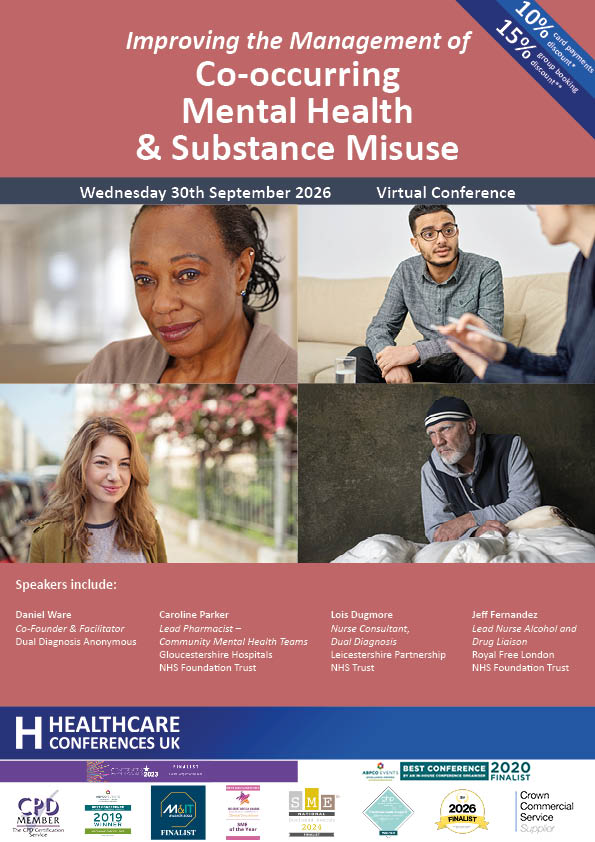
This important conference focuses on improving care, treatment and outcomes for people with co-occurring mental health and substance use conditions.
The new DHSC and NHS England Co-occurring Mental Health and Substance Use Delivery Framework, published in December 2025, makes clear that drug, alcohol and mental health problems are often co-occurring rather than separate problems to be addressed independently. The framework highlights that services too often fail to meet people’s needs, and that people can be excluded from mental health services until their drug or alcohol use is resolved, while also being excluded from substance use services until their mental health needs have been addressed. The framework reinforces two key principles for practice: “everyone’s job” and “no wrong door”. Commissioners and providers of mental health, alcohol and drug use services have a joint responsibility to meet people’s needs, and every contact point should be able to provide access to support, treatment and joined-up care.
The scale of need is significant. The delivery framework reports that between 2024 and 2025, 74% of people starting drug and alcohol treatment had a mental health treatment need. It also highlights that, between 2010 and 2020, 47% of people in contact with mental health services in England who died by suicide had a problem with alcohol use, and 38% had a problem with drug use. This makes co-occurring mental health and substance use a major priority for mental health services, drug and alcohol treatment services, emergency care, primary care, local authorities, housing, homelessness services and the voluntary sector. This conference will provide a timely update on the new delivery.
The conference will include learning from lived experience and from organisations that have improved services for people with co-occurring needs. It will focus on challenging stigma, improving early intervention and prevention, supporting trauma-informed practice, and ensuring adherence to NICE guidance on coexisting severe mental illness and substance misuse. Practical case studies will explore making services more accessible, supporting people experiencing homelessness and multiple disadvantage, improving joint risk management, developing data sharing arrangements, and embedding lived experience in service review, planning and development.
By attending this conference, you will have the opportunity to reflect on how your service can implement the delivery framework in practice, improve integrated working between mental health and drug and alcohol services, reduce exclusion from care, and develop a more compassionate, effective and coordinated response for people with co-occurring mental health and substance use needs.
This conference will enable you to:
Network with colleagues who are working to improve services, practice and treatment for people experiencing co-occurring mental health and substance use conditions
Reflect on the lived experience of people with co-occurring mental health and substance use needs, and understand the impact of fragmented care, stigma and repeated service exclusion
Understand the implications of the DHSC and NHS England Co-occurring Mental Health and Substance Use Delivery Framework and the four priority areas for local implementation
Embed the principles of “everyone’s job” and “no wrong door” into service design, referral pathways and frontline practice
Learn from the latest national developments, including the Royal College of Psychiatrists report on co-occurring substance misuse and mental health disorders
Improve strategic leadership and joint working across mental health services, drug and alcohol treatment services, local authorities, primary care, housing, homelessness services and the voluntary sector
Develop integrated pathways that reduce exclusion criteria, avoid sequential models of care and ensure people are not passed between services
Update your knowledge of NICE guidance on coexisting severe mental illness and substance misuse, and understand how to apply this in practice
Improve routine assessment, screening and identification of substance use in mental health settings, including the use of validated tools such as ASSIST-Lite and AUDIT-C
Understand how brief interventions, signposting, supported referral, mutual aid and harm reduction can be embedded into routine care
Improve inpatient provision for people presenting with co-occurring mental health needs and substance dependence, including the safe assessment and management of withdrawal
Develop trauma-informed approaches that reduce re-traumatisation and improve engagement, continuity and trust
Strengthen local data collection, monitoring and information sharing to better understand unmet need, service access, outcomes and inequalities
Improve joint risk management, crisis planning and suicide prevention for people with co-occurring mental health and substance use needs
Understand how to support people who experience homelessness, multiple disadvantage, poverty, discrimination, loneliness and trauma
Improve access to NHS Talking Therapies and psychological support for people with drug and alcohol use needs through better screening, advice and joint working
Supports CPD professional development and acts as revalidation evidence. This course provides 5 Hrs training for CPD subject to peer group approval for revalidation purposes