
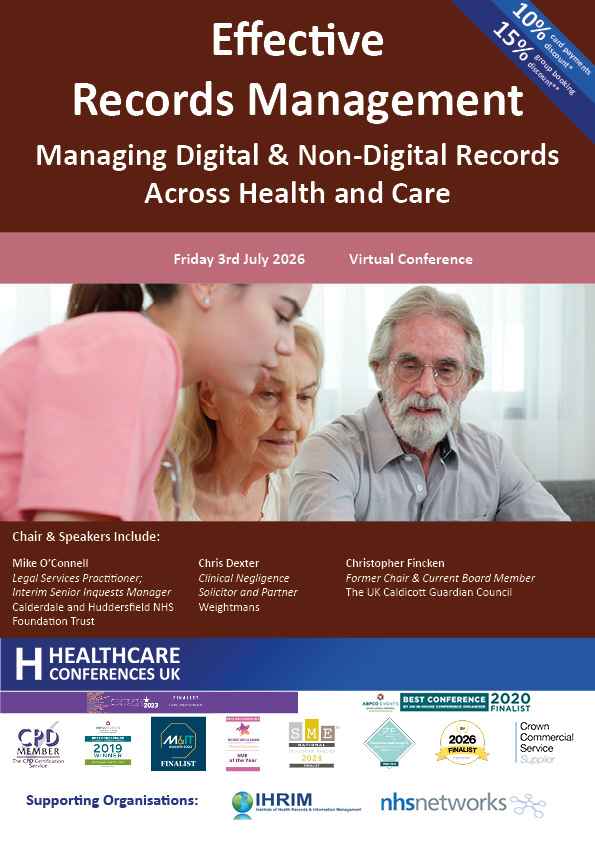
As the NHS moves from analogue to digital, high-quality documentation and records management have become central to patient safety, legal defensibility, digital transformation and patient trust. The government’s 10 Year Health Plan sets out a future built around the NHS App, a Single Patient Record and more digitally enabled pathways, while NHS England’s 2026/27 planning framework expects rapid progress on electronic patient record coverage, digital access and ambient voice technology. At the same time, organisations must still meet the fundamentals: clear, contemporaneous, accurate and secure records that support safe care, stand up to scrutiny, and comply with the Records Management Code of Practice.
“Record keeping is essential to the provision of safe and effective care… Records include anything that refers to the care of the patient and records can be called in evidence as part of coroners inquests or criminal proceedings, investigations, fitness to practice hearings, serious incident and disciplinary investigations…The approach to record keeping that courts of law adopt tends to be that ‘if it is not recorded, it has not been done’. Good record keeping shows how decisions related to patient care were made, while poor record keeping increases the risk of harm when making decisions.”
NHS Professionals
“Everyone within a health and care organisation is responsible for managing records appropriately. It is therefore important that you understand how records should be managed - how records are created, maintained and disposed of appropriately.”
Records Management Code of Practice NHS England
“Over the next ten years they will result in an NHS where digital access to services is widespread. Where patients and their carers can better manage their health and condition. Where clinicians can access and interact with patient records and care plans wherever they are, with ready access to decision support and AI, and without the administrative hassle of today.”
NHS Long Term Plan
This conference examines what good record keeping now looks like in 2026: using standards to improve interoperability and care planning, documenting deterioration and escalation, preventing inappropriate access, supporting online patient access to records, managing redaction and third-party information safely, and learning from complaints, claims, coroners’ inquests and patient safety incidents.
It will also explore how organisations can improve data quality as records become more visible to patients, more shareable across systems, and more central to digital-first models of care. The conference will discuss the use of AI in records including clinical note taking and the use of AI to create documents such as those needed for discharge, and patient access to records including working with patients to improve care records, supporting them to use the NHS App, and managing redactions where appropriate for safeguarding purposes.
Learning Outcomes
This conference will enable you to:
Network with colleagues who are working to improve documentation and record keeping
Learn from outstanding practice in meeting record keeping standards
understand how the 10 Year Health Plan, NHS App roadmap and 2026/27 planning framework are changing expectations for documentation and records management
update your practice in line with the Records Management Code of Practice and current ICO guidance
improve documentation to support patient safety, PSIRF, Martha’s Rule and legal defensibility
strengthen data quality in EPRs and shared records, including allergies, risk and care planning
manage patient access, redaction, third-party information and inappropriate access more confidently
identify how AI-enabled documentation and ambient voice technology may affect record quality, workflow and governance
Learn from cases, claims and coroner’s inquests and the coroner perspective
Understand legal, professional, organisational and individual responsibilities when managing records
Explore issues around handwritten clinical notes, emails, care plans, diagnosis recording and observation charts
Improve the way you train and support staff to improve documentation and record keeping
Develop your skills in involving patients in their health and care record and the NHS App
Identify key strategies for ensuring information is shared appropriately and documented effectively with an audit trail
Self assess and reflect on your own practice, gain 5 hours CPD for professional development and revalidation (subject to peer group approval)